

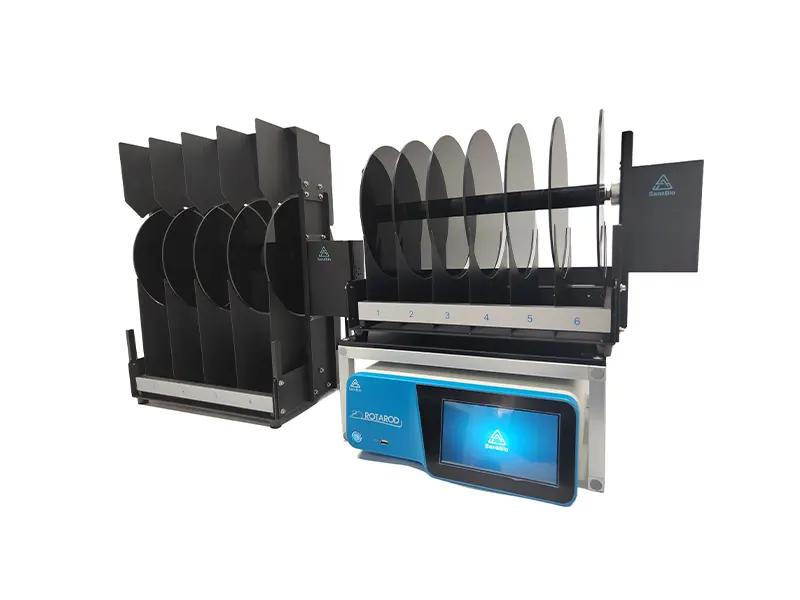
A RotaRod can help researchers examine balance, movement control, and motor performance under a defined physical challenge. During testing, rodents maintain their position on an elevated rotating rod as the rotational conditions change.
Choosing a suitable system requires attention to species, lane configuration, test modes, fall detection, data handling, and how the equipment fits the planned protocol. For laboratories establishing repeatable procedures, these practical factors are as relevant as the headline specifications.
Define the Research Purpose
Begin by identifying what the experiment needs to measure. RotaRod testing can evaluate motor coordination, balance, and motor performance. It can also be incorporated into studies of motor deficits and drug effects on motor function.
The intended endpoint influences the operating mode, test duration, training process, and data that should be recorded.
For repeated studies, consider how baseline and follow-up sessions will be conducted. Keeping relevant settings and handling procedures consistent makes results easier to compare across animals and experimental groups.
Match the Configuration to the Species
Mouse and rat testing involves different physical requirements. Rod diameter, fall height, lane number, and overall frame dimensions are worth checking before equipment selection.
Laboratories working with both species may also benefit from a configuration that can accommodate each animal type without requiring a separate control setup.
The BioMed Easy RotaRod supports six mice or four rats using the same control unit. Its mouse version, SA102M, has six lanes, a 30 mm rod diameter, and a 20 mm fall height. The rat version, SA102R, has four lanes, a 60 mm rod diameter, and a 30 mm fall height.
Compare Rotation Modes for the Rotarod for Mice
Rotation settings should correspond with the planned behavioral challenge. Constant speed keeps rotational demand stable, while uniform acceleration gradually increases the challenge. Reverse-ramp, rocking, and custom ramp options provide additional protocol choices when the experimental design requires different movement profiles.
The system offers a speed range of 0.05–100 RPM in 0.1 RPM steps. It supports constant, uniform acceleration, reverse ramp, and rocking modes, with eight protocol configurations available for experimental setup. Researchers can therefore compare protocols based on how much control they need over rotational demand.
Look at Fall Detection and Recorded Outcomes
The detection method affects how falling events are captured. The RotaRod uses a precision infrared sensor to detect an animal’s fall automatically. Test outputs include latency, initial speed, final speed, acceleration speed, drop speed, revolution count, ramp, and rotating mode.
These measurements give researchers more context than a single fall-time value. For example, final or drop speed can be considered alongside latency when reviewing results from an accelerating protocol. The important point is to define which variables are primary before collecting data.
Assess Operation and Data Storage
A system should also fit the way the laboratory operates day to day. The RotaRod uses a 7-inch capacitive IPS LCD touchscreen, with start and stop functions available through the screen or TTL signal control. It can operate without a PC, and experimental data can be saved to a USB flash drive as CSV files.
The internal storage holds more than 2,000 data records. The system can also save eight projects, with information including animal ID, age, weight, gender, and notes. These features can help researchers organize records across different protocols and maintain useful context alongside the numerical results.
Consider Training and Standardization
Pre-training familiarizes animals with the rotating rod prior to formal testing. Per the official protocol, animals are first habituated to the testing room, then trained on the RotaRod three times daily for three consecutive days—with at least 15 minutes between sessions on the same day.
Researchers should document the training schedule, test mode, speed settings, trial duration, rest intervals, and any deviations from the planned protocol. A written procedure makes it easier for different operators to follow the same experimental sequence.
Select a RotaRod for Mice and Rats That Fits Future Needs
A mouse-appropriate RotaRod for mice should align with the study’s objectives; a dual-species model is practical for facilities also testing rats. Evaluate physical design, programmable rotation modes, detection method, output variables, data storage, and export capabilities holistically—not in isolation.
As a subsidiary of SANS Biotechnology, BioMed Easy Technologies designs and manufactures equipment and software for animal behavior, neuroscience, physiology, and preclinical research. Its official website states CE and ISO 9001 certification, a 2016 founding year, and support for 3,000+ global laboratories.
Its product portfolio spans behavioral research categories from motor coordination and pain to learning, memory, anxiety, fear, reward, and metabolism.
Species-specific configurations, programmable test modes, and integrated record management with project storage and USB-based data handling allow the RotaRod to serve mouse and rat motor coordination studies.
Questions about configuration, technical support, training, and after-sales service can be directed to BioMed Easy when finalizing a RotaRod workflow. This approach can also help laboratories compare initial setup needs with future study requirements.
