

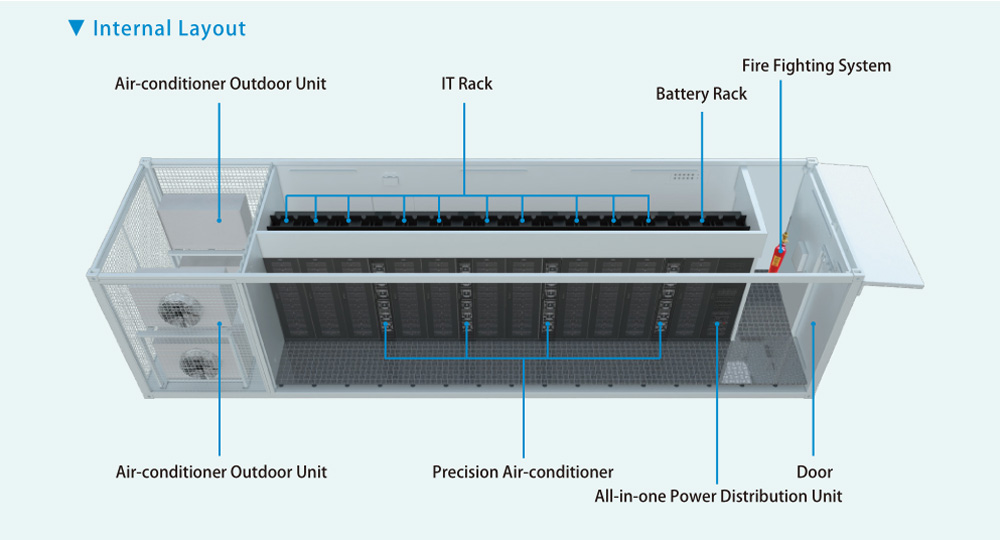
Prefabricated data centers change the traditional construction process by completing much of the engineering, assembly, and testing before infrastructure reaches its final location. Instead of installing every major subsystem independently on site, power, cooling, IT racks, monitoring, and related equipment can be integrated into a standardized module and delivered as a coordinated system. The process helps explain why prefabrication has become a practical option for projects that require controlled deployment and predictable installation.
It Starts with the Requirements, Not the Building
Before manufacturing begins, the project team defines the technical conditions the data center must satisfy. Expected IT load, available space, power capacity, cooling demand, environmental conditions, redundancy requirements, and potential expansion all influence the final configuration.
The application also matters. An industrial site may need local computing for automation and monitoring, while an edge facility may prioritize compact deployment. Larger enterprise projects may place greater emphasis on capacity growth and serviceability.
Once these requirements are established, engineers can determine how racks, UPS equipment, batteries, power distribution, cooling, monitoring, and other systems should work together. This planning stage is important because prefabricated data centers are based on an integrated design rather than a collection of independent installations.
The Infrastructure Is Integrated Before Delivery
The next stage moves from engineering into manufacturing. Components are positioned according to the approved design, and the major subsystems are connected within a controlled production environment.
KSTAR develops modular and containerized data center infrastructure alongside UPS, battery, and cooling solutions. Its containerized data center approach integrates key systems before deployment, allowing the internal infrastructure to be prepared as a coordinated unit rather than assembled piece by piece after arrival.
Factory integration can also improve consistency. When similar facilities are required across multiple locations, standardized designs and manufacturing procedures make it easier to reproduce the core infrastructure while adjusting capacity for individual sites.
Why Factory Assembly Changes the Project Schedule
One of the clearest differences between prefabricated and conventional construction is where the work takes place. In a site-built project, electrical installation, cooling, rack deployment, cabling, and system integration may all depend on progress at the customer’s location.
With prefabrication, many of these activities can take place at the factory while the project site is being prepared separately. The two workstreams can move forward at the same time, reducing some of the scheduling dependencies that can slow conventional construction.
This does not eliminate site work, but it changes its nature. Instead of building the complete infrastructure from individual components, the site team primarily prepares the foundation or placement area, completes external connections, and carries out commissioning.
Testing Before the Module Leaves the Factory
Testing is a critical part of the workflow. Once the systems are integrated, the manufacturer can verify equipment connections, system interfaces, and operating functions before transportation.
KSTAR’s official container data center information describes a factory-built and factory-tested approach in which UPS, power distribution, batteries, cooling systems, and racks are integrated before delivery. This allows potential integration issues to be identified in a controlled environment rather than during final installation.
Testing is particularly important for critical infrastructure because power and cooling systems need to operate together with the IT environment. Checking these relationships before shipment can make the commissioning stage more structured.
What Happens When It Reaches the Site?
Transportation brings the completed module into the second major phase of the process. Delivery planning has to account for module dimensions, weight, access routes, lifting arrangements, and the physical conditions of the destination.
After positioning, the project team connects the infrastructure to external power, grounding, network services, and other required utilities. The exact work depends on the site and the configuration selected during the design phase.
This is where the value of factory integration becomes visible. Because much of the internal infrastructure has already been assembled, the project does not need to repeat the entire installation sequence at the destination.
Power and Cooling Become Operational Together
Commissioning then focuses on verifying that the integrated infrastructure performs as intended. The electrical system must provide stable power to the IT environment, while the cooling system needs to maintain suitable thermal conditions under expected loads.
Cooling is especially important as equipment density increases. Rack arrangement, containment, airflow, and cooling equipment should be considered together rather than treated as separate systems.
This integrated design philosophy is one reason prefabricated data center architectures can simplify deployment. The major infrastructure relationships are defined before delivery, allowing the final site to concentrate on connections, validation, and operational readiness.
Expansion Does Not End with Initial Deployment
A prefabricated data center can also be designed around future requirements. IT workloads rarely remain unchanged throughout an infrastructure lifecycle. New applications, additional servers, or business expansion can increase the required capacity.
A modular architecture makes it possible to plan for these changes during the initial project. Future power demand, cooling capacity, available space, maintenance access, and compatibility with additional modules should all be considered before the first unit is installed.
This approach can help organizations avoid treating the initial deployment as a fixed endpoint. Instead, the infrastructure can become part of a longer-term capacity strategy.
When Containerized Designs Make Practical Sense
Containerized prefabrication is particularly relevant when organizations need computing capacity outside conventional data center campuses. Remote industrial facilities, edge locations, distributed operations, and sites with limited available space may benefit from a compact integrated structure.
The physical enclosure provides a controlled environment while the internal systems deliver core data center functions. Because those systems can be assembled and tested before delivery, deployment can be more standardized than building every component independently at the destination.
For projects with these characteristics, container data center solutions can combine IT infrastructure with power, cooling, and monitoring within a coordinated architecture.
The Full Process in Practice
A prefabricated data center therefore follows a clear sequence: define requirements, engineer the system, manufacture and integrate the components, perform factory testing, transport the completed module, connect external utilities, and commission the finished infrastructure. Future capacity can then be added according to the original expansion strategy.
The main difference from conventional construction is that more of the complex work happens before the system reaches the customer site. This can make deployment more structured while giving organizations a practical way to establish data center capacity in locations where traditional construction may be slower or more difficult.
