

Industrial facilities that handle flammable gases and vapors require more than accurate gas measurement. The detection equipment itself must not become an ignition source. This is where intrinsic safety becomes important. For operators working in oil and gas, chemical processing, refining, mining, and related industries, understanding hazardous-area classifications and equipment protection methods is essential when selecting a Gas Detector.
What Does Intrinsic Safety Mean?
Intrinsic safety is a protection technique designed to prevent electrical equipment from releasing enough energy to ignite a hazardous atmosphere. Instead of relying primarily on a heavy enclosure to contain an explosion, an intrinsically safe device limits electrical and thermal energy so that sparks or heat generated during normal operation or specified fault conditions cannot cause ignition.
This distinction matters in locations where flammable gases or vapors may be present. OSHA states that equipment approved as intrinsically safe can be used in hazardous classified locations for which it is specifically approved. Equipment must therefore match the classification and conditions of the intended location rather than being assumed safe simply because it is a gas monitoring instrument.
Understanding Hazardous Area Classifications
Before selecting a Gas Detector, users should understand how the workplace is classified. Under the U.S. Class and Division system, Class I locations involve flammable gases or vapors. Class I, Division 1 generally covers areas where ignitable concentrations can exist under normal operating conditions or may frequently occur during maintenance or repair.
Class I, Division 2 describes areas where flammable gases or vapors are normally confined within closed systems and could become hazardous because of an accidental release, abnormal operation, or ventilation failure. OSHA also recognizes Class I Zone 0, Zone 1, and Zone 2 classifications under the zone system.
The classification should always be established for the specific workplace. OSHA notes that hazardous locations are determined according to the properties of the flammable material and the likelihood that a flammable concentration will be present. Each room, section, or area should therefore be evaluated individually.
Check the Protection Marking Before Purchase
A common mistake is choosing equipment because the product description says it is explosion-proof or suitable for industrial use. Those descriptions alone are insufficient. Buyers should examine the actual certification or protection marking and confirm that it corresponds with the hazardous area where the equipment will operate.
For example, OSHA explains that equipment approved for hazardous locations must be appropriate not only for the location classification but also for the ignitable properties of the specific gas, vapor, dust, or fiber involved. Markings can also identify applicable gas groups and temperature classifications.
This means procurement teams should verify the complete approval information rather than focusing on a single term such as Ex or intrinsically safe. The required protection method, gas group, temperature class, and area classification all need to be compatible with the site conditions and applicable regulations.
Consider the Gas and Detection Method
Intrinsic safety addresses ignition risk, but it does not determine whether a sensor is appropriate for a particular gas. Selection should begin with identifying the substances that may be present and the concentrations that need to be detected.
Combustible gases, oxygen, and toxic gases can require different sensing technologies. A single-gas detector may be suitable for a focused hazard, while a multi-gas instrument can be more practical where several atmospheric hazards must be monitored simultaneously. Portable equipment can also support inspections, leak checks, confined-space work, and changing work locations.
Sampling method is another important consideration. Diffusion instruments monitor gases reaching the sensor naturally, while pump-assisted instruments can actively draw samples from a remote location. The appropriate approach depends on the monitoring task, distance from the potential source, and site procedure.
A Portable Option for Hazardous-Area Monitoring
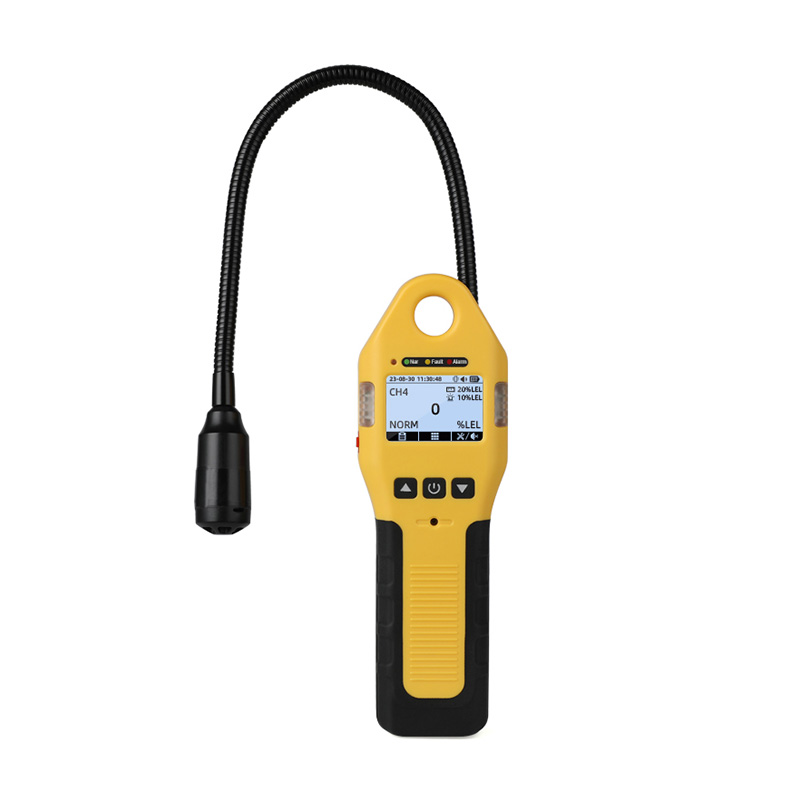
When selecting portable equipment, users should examine the manufacturer’s actual specifications and protection information. Bosean‘s S-100 Gas Leak Detector is one example from its portable gas detection range. According to the official product page, the instrument uses natural diffusion sampling and is designed for applications including petroleum, chemical, environmental protection, smelting, refining, and biochemical medicine.
The S-100 has an Ex-protection marking of Ex ib IIC T3 Gb, making the protection specification an important reference when evaluating its suitability for a particular hazardous-area application. Its listed dimensions are 208 × 66 × 36 mm without the gooseneck tube, and its working time is at least 10 hours.
The instrument also provides sound, light, vibration, and display alarms. Its specified operating condition is -25°C to 55°C with humidity below 95%RH without dew, while the sensor life is listed as five years. These details should be reviewed alongside the site’s gas type, hazardous-area classification, and operating conditions before deployment.
Practical Checklist for Gas Detector Selection
A systematic selection process can reduce the risk of using unsuitable equipment. First, identify the gases and vapors that may be present. Next, confirm the hazardous-area classification and determine whether the required protection method is intrinsic safety or another approved technique.
Then check the equipment’s certification marking, gas compatibility, temperature rating, sampling method, detection range, alarm functions, environmental limits, battery requirements, and maintenance procedure. OSHA specifically advises confirming that portable monitoring instruments are approved for the environment before entering a hazardous location and using only the battery specified by the safety approval.
Calibration should receive equal attention after purchase. OSHA recommends proper maintenance and calibration of direct-reading monitors and emphasizes following the manufacturer’s recommendations. A certified instrument cannot compensate for poor maintenance, incorrect configuration, or unsuitable operating practices.
About Bosean
Bosean combines gas detection expertise with a strong foundation in technical development and product quality. The company holds hundreds of patents, certifications, and awards, while its products have obtained domestic and international qualifications including explosion-proof, fire safety, SIL, and IECEx certifications.
When selecting a Gas Detector for hazardous-area applications, buyers can review these qualifications alongside their specific site requirements. For further information about product suitability, specifications, or project requirements, “Contact Us” to discuss the appropriate gas detection solution.
