

A battery system does more than hold electricity until it is needed. In a commercial, industrial, or utility project, it must also control heat, electrical stress, charging behavior, operating limits, and power flow across thousands of individual components.
Safety and efficiency therefore come from the same engineering discipline: keeping the system within stable conditions while moving energy with as little unnecessary loss as possible. Modern energy storage solutions increasingly combine physical protection, thermal management, power electronics, monitoring, and software within one coordinated architecture.
Safety Begins With Predictable Battery Conditions
Battery safety depends heavily on whether cells operate within controlled electrical and thermal boundaries. Excessive temperature, large temperature differences, abnormal voltage, and uncontrolled current can accelerate degradation or create conditions in which faults become more difficult to contain.
Advanced energy storage technology addresses these risks through coordinated monitoring and protection at cell, module, electrical, structural, fire-protection, and system levels. The objective is to detect deviation early enough that the affected part of the system can be limited, isolated, or returned to a safer operating range.
Thermal management is especially important because battery behavior changes with temperature. Uneven heat distribution can cause cells in the same pack to age at different rates, which gradually reduces usable capacity and complicates control. Well-designed energy storage solutions use cooling, sensing, and operating limits to maintain more consistent conditions across the battery.
A more uniform thermal environment supports predictable charge and discharge behavior, while layered protection reduces the chance that a local problem develops into a system-wide event.
Efficiency Is a System-Level Result
System efficiency cannot be judged only by the nominal efficiency of the battery cells. Electricity also passes through conversion equipment, conductors, auxiliary systems, cooling equipment, controls, and sometimes transformers before it is delivered back to the load or grid. Each stage introduces some loss, so energy storage technology must coordinate the complete conversion path.
A system that keeps batteries within a suitable temperature range, avoids unnecessary auxiliary consumption, and operates close to its intended power window can preserve more of the energy that was originally stored.
Operating strategy matters as much as hardware. If charging and discharging occur at poorly selected times, a technically efficient system may still produce weak operational results. Energy storage solutions are therefore often connected with energy-management functions that align battery dispatch with peak shaving, frequency regulation, capacity trading, emergency backup, or other defined objectives.
Efficiency also depends on whether stored energy is available when it has the greatest technical or commercial value.
Control Architecture Connects Protection and Performance
As systems become larger, manual supervision is no longer sufficient for coordinating battery condition, power conversion, alarms, and dispatch. A digital control layer can consolidate operating data and give site operators a clearer view of system status. In practical energy storage technology, monitoring and management functions form the link between physical equipment and operating decisions.
Data from the battery can indicate whether power commands are appropriate, while alarms and diagnostics can guide maintenance before minor irregularities become prolonged interruptions.
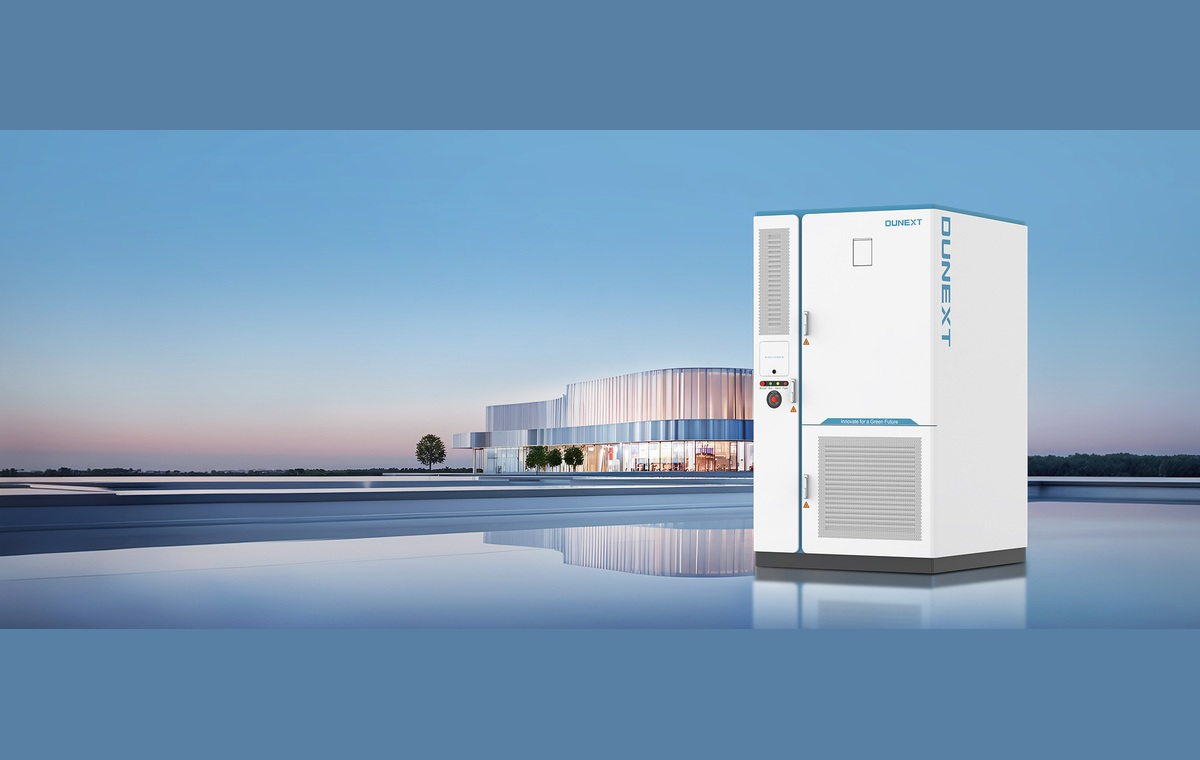
Dunext illustrates how this integration can be applied across different project scales. Its portfolio covers compact systems around 50 kWh through large-scale systems above 5 MWh, including PowerHill liquid- and air-cooled cabinets, PowerRock and PowerRack products, PowerMount containerized systems, and the DuLink management platform.
These energy storage solutions are positioned for commercial and industrial as well as utility applications, so the same broad principle—coordinating storage hardware with system management—can be adapted to different capacities and operating requirements rather than being confined to a single product format.
Scale Changes the Engineering Priorities
A small commercial installation and a multi-megawatt utility project store energy for different reasons and face different operational constraints. At smaller sites, space, installation simplicity, backup requirements, and coordination with business loads can dominate design decisions.
At utility scale, dispatch reliability, grid interaction, lifecycle management, and the ability to maintain performance across a much larger equipment base become more prominent. Advanced energy storage technology therefore needs an architecture that can scale without losing visibility into individual battery conditions or introducing unnecessary complexity into project operation.
Dunext supports operating and business models that include peak shaving, frequency regulation, capacity trading, and emergency backup power. Its commercial and industrial solution is organized around business energy use, while its utility solution addresses grid-side operation and efficiency.
The company also combines research and development, manufacturing, and service capabilities, reports more than 3 GWh of shipments, operates five overseas subsidiaries, and has two manufacturing centers. Those facts do not replace project-specific engineering, but they show how energy storage solutions increasingly depend on coordinated product, manufacturing, control, and service capabilities rather than on battery capacity alone.
The technical direction is therefore clear: safer storage is also more controllable storage, and more controllable storage can be operated more efficiently. Protection layers, thermal consistency, conversion equipment, digital supervision, and dispatch logic all influence the same operating outcome.
A mature system does not separate safety from performance; it treats both as consequences of disciplined control over the battery from cell level to project level. As storage becomes a larger part of commercial facilities and power networks, the value of advanced storage systems will increasingly be measured by how consistently they maintain that balance throughout real operation.
