

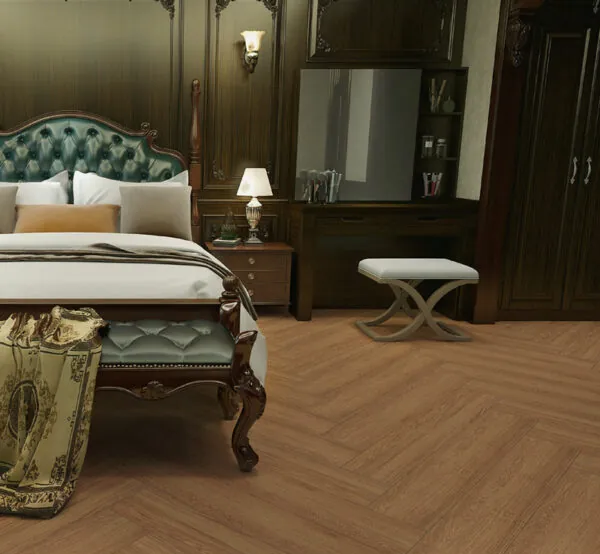
Natural timber flooring offers organic grain variation that many designers and property owners value. However, wood is vulnerable to dimensional change under moisture and temperature fluctuation, and it requires ongoing maintenance such as sanding and refinishing to preserve surface condition. These practical constraints lead many commercial and residential projects to consider ceramic alternatives that reference wood aesthetics without the associated upkeep demands.
Wood effect porcelain tiles have become an established product category within the ceramic market. Advances in manufacturing allow producers to apply printed grain patterns and surface textures that reference timber aesthetics. For buyers, the specification decision now centers on selecting formats and finishes suited to the intended application, installation method, and long-term maintenance capacity of the space.
Why Wood-Look Porcelain Has Replaced Natural Timber in Many Applications
The primary vulnerability of natural wood in interior applications remains its dimensional instability under temperature and moisture fluctuations. While engineered boards reduce this tendency, they generally cannot match the remarkably low water absorption of vitrified porcelain. In active environments like kitchens, basements, and commercial areas requiring frequent cleaning, natural wood may swell, warp, or harbor moisture within joints. Wood effect porcelain tiles mitigate these risks while delivering robust abrasion resistance. Furthermore, responsibly manufactured porcelain can offer favorable lifecycle assessments when durability and reduced maintenance cycles are factored into the environmental evaluation, making it a sustainable choice for long-term projects.
JLA Ceramics manufactures these wood-look surfaces across dedicated production lines, utilizing the same high-temperature vitrification processes applied to its broader flooring collections. Operating two separate factories with a combined monthly output exceeding one million square meters, JLA Ceramics supports large-scale commercial specifications where traditional timber would prove impractical or cost-prohibitive.
Room-by-Room: Where Wood Effect Porcelain Performs Best
Bathrooms and wet rooms are common applications for wood-look porcelain, as the material tolerates moisture and steam exposure better than natural timber. Kitchens also benefit from porcelain’s resistance to staining and impact, though buyers should verify that selected products carry appropriate slip-resistance ratings for wet-area flooring. In commercial hospitality settings such as hotel lobbies and restaurant dining areas, wood-look porcelain provides a surface that withstands public foot traffic while maintaining a consistent appearance over time. Exterior applications may be viable in some climates, provided buyers confirm that selected products meet frost-resistance requirements and local building codes for outdoor installations.
The collection from JLA Ceramics spans various formats suited for residential wet areas through to expansive commercial lobbies. This comprehensive range enables procurement teams to specify materials across diverse project types, maintaining aesthetic continuity between dry interior zones and demanding wet environments without needing to switch manufacturing partners.
Understanding Surface Texture and Finish Variation
The credibility of a wood-look surface relies on physical texture just as heavily as its printed coloration. Early product generations often utilized flat glazes with photographic grain, resulting in a visual but non-tactile correspondence to timber. Contemporary manufacturing utilizes synchronized embossing, aligning surface relief with the printed grain pattern to create realistic ridges and saw-cut textures. Matte finishes typically replicate oiled wood, while satin glazes suggest varnished surfaces. The depth of this embossing impacts daily maintenance; micro-textured finishes balance aesthetic realism with practical cleanability, whereas deeply textured surfaces may require more intensive cleaning protocols to prevent debris accumulation.
Quality verification protocols at JLA Ceramics evaluate both surface texture consistency and glaze adhesion across every production batch. This systematic testing ensures that the tactile character and embossing depth approved in initial samples are reproduced reliably during bulk manufacturing, avoiding the over-glazed appearance that can undermine the organic timber illusion.
Color and Grain: Matching Design Palettes
Wood effect porcelain tiles are available in a color spectrum that often exceeds the natural range of standard timber species. Pale grays and bleached whites complement coastal and Scandinavian interior designs effectively. Medium-tone oaks and warm walnuts bridge traditional and transitional architectural languages, while near-black ebony tones anchor contemporary minimalist layouts. Beyond base coloration, grain density plays a critical role: straight, fine grains read as formal and modern, whereas pronounced knotting introduces rustic character. Buyers should evaluate physical samples alongside adjacent stone and metal finishes under site-specific lighting to gauge actual color performance.
JLA Ceramics produces wood-look tiles across an extensive range of tones and grain densities, accommodating subdued contemporary palettes and characterful traditional options alike. For projects requiring proprietary tones that align closely with specific branded interior schemes, the company also provides tailored custom color and OEM manufacturing services.
Format Size and Plank Dimensions
Plank dimensions significantly influence the spatial perception of any flooring installation. Narrow planks with varied lengths establish a traditional rhythm often reminiscent of historic parquet flooring. Conversely, wider planks in consistent lengths produce an expansive, contemporary feel well-suited to open-plan commercial layouts. Tile thickness also warrants consideration: thinner formats prove economical and compatible with standard adhesive systems, while thicker profiles accommodate heavier commercial loads and frequent traffic. Minimizing joint widths during layout planning remains an important strategy for preserving the visual illusion of continuous timber boards.
The wood-look portfolio from JLA Ceramics includes multiple plank widths and varying lengths. This dimensional variety allows interior designers to specify formats aligning with their intended spatial character, whether they aim to replicate historic narrow boards or achieve the seamless expanse associated with wide contemporary timber planks.
Installation and Grout Considerations
Achieving a convincing organic illusion depends heavily on installation precision and careful planning. Substrate flatness tolerances are generally stricter for long planks than for standard square formats, as uneven subfloors create lippage that disrupts the continuous plane. Grout color selection is equally critical; contrasting grout emphasizes the modular nature of the surface, while color-matched grout minimizes visual interruption. Planks with rectified edges allow for very narrow joints, further enhancing the seamless appearance. Installers must also plan expansion joints at regular intervals to accommodate structural movement without stressing the surface.
JLA Ceramics provides after-sales technical support that includes installation guidance. The team can address questions related to layout planning and installation considerations for wood-look porcelain plank formats, helping buyers coordinate their project requirements with the selected products.
Sourcing Wood Effect Porcelain Tiles for Your Project
Selecting a reliable supplier for wood-look surfacing involves evaluating print resolution, embossing accuracy, batch color consistency, and accessory availability. Physical samples are essential, as digital screens cannot adequately convey how surface texture interacts with directional light in a physical room. Procurement teams should also confirm the supplier’s capacity to produce matching stock for future extensions, as complex grain patterns are susceptible to noticeable variation between mismatched production runs over time.
JLA Ceramics operates as a professional tile manufacturer based in Foshan, China, offering an extensive collection of wood effect porcelain tiles alongside dedicated OEM and custom design services. With significant production experience, strict quality assurance protocols for color consistency, and extensive export logistics expertise, JLA Ceramics supplies reliable surfacing solutions for residential and commercial environments. To browse wood effect porcelain plank formats and finishes, visit JLA Ceramics.
