

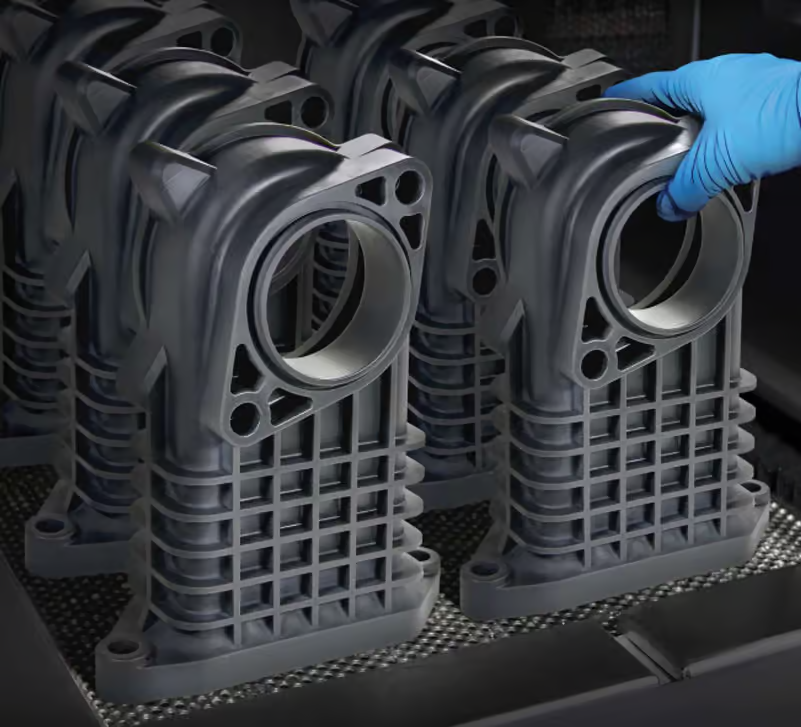
In traditional manufacturing environments, complex machinery often relies on intricate assemblies comprising dozens, sometimes hundreds, of individual components. Each discrete piece requires separate fabrication, specialized tooling, independent sourcing, and rigorous quality control. Production managers and engineers frequently face a critical, recurring question: “How can we reduce the number of individual parts in a complex assembly to cut costs and assembly time, without compromising the system’s overall function and reliability?”
Conventional manufacturing approaches, including CNC machining and casting, often face challenges producing complex internal geometries within a single monolithic part.This physical limitation frequently necessitates splitting ideal designs into multiple machinable segments that must later be welded, brazed, or bolted together. Today, engineers are increasingly turning to digital fabrication methods to overcome these historical hurdles. By building components directly from digital models, manufacturers can fundamentally rethink how parts are designed, optimized, and assembled on the factory floor.
Rethinking Design with Advanced 3d metal printing technology
The shift toward true part consolidation begins entirely at the design phase. When utilizing advanced 3d metal printing technology, designers are no longer bound by the physical limitations of cutting tools, tool clearance angles, or draft angles required for casting molds. Because the Selective Laser Melting (SLM) process builds parts layer by layer using fine metal powders, it can successfully generate complex, enclosed, or deeply intertwined structures that are otherwise impossible to machine.
Instead of designing a primary housing, a secondary cover, an internal manifold, and the assorted fasteners to connect them, an engineer can design a single, continuous component. This part-consolidation strategy cuts down assembly-related engineering workload. It can reduce hours spent developing assembly documentation, defining bolt torque requirements, and computing tight tolerances for mating interfaces across multiple discrete components.
Eliminating Points of Failure: The Structural Advantage
Every joint, weld seam, and mechanical fastener in an assembly represents a potential point of failure. Operational vibrations, thermal expansion cycles, and mechanical stress tend to target these specific connection points first. When a multi-part assembly is successfully consolidated into a single monolithic unit, these vulnerable assembly-related interfaces can be removed.
The resulting consolidated component typically exhibits superior structural integrity. Furthermore, traditional assemblies often require overlapping flanges or thicker material sections simply to accommodate bolts or welding seams. By removing the need for these bulky connection mechanisms, engineers can utilize topology optimization software to remove unnecessary mass. This leads to a final consolidated part that is not only structurally robust but often significantly lighter than its multi-part predecessor.
Real-World Application Scenarios in B2B Sectors
The practical and financial benefits of part consolidation are most evident in highly demanding industrial applications. Consider the aerospace sector, where complex fluid routing systems are vital. Historically, a hydraulic manifold might consist of twenty distinct machined aluminum pieces, meticulously brazed and bolted together. This traditional approach is labor-intensive, heavy, and prone to micro-leakage at the seams over time.
By adopting metal additive manufacturing, aerospace engineers may fabricate the entire manifold as a single continuous component from high-performance alloys such as titanium or Inconel, removing leak risks associated with assembly joints.The internal fluid channels can be curved and geometrically optimized for ideal flow dynamics, rather than being restricted to straight, drillable intersecting lines. Similarly, in the automotive and energy sectors, complex heat exchangers can be consolidated from multiple thin sheets and brazed joints into a single, highly efficient structure. This improves thermal transfer efficiency while simultaneously shrinking the physical footprint of the cooling system, leading to better overall vehicle or generator performance.
Simplifying the Supply Chain and Inventory Management
Beyond the physical and performance properties of the manufactured part, consolidation dramatically impacts supply chain logistics and overhead. Managing the procurement for a fifty-part assembly requires sourcing raw materials and finished goods from multiple vendors, coordinating complex delivery schedules, and maintaining extensive warehouse inventory. If a single specialized fastener is delayed, the entire production assembly line can stall.
Consolidating those fifty parts into a single printed component streamlines the entire procurement process from end to end. Manufacturers generally only need to manage the digital CAD file, a single machine setup, and the raw metal powder supply. This massive reduction in inventory complexity significantly lowers warehousing costs, reduces administrative overhead associated with tracking multiple SKUs (Stock Keeping Units), and mitigates the risk of sudden supply chain disruptions.
Furthermore, by reducing assembly labor and the need for specialized assembly fixtures, companies can achieve a faster return on investment and a lower total cost of ownership for their manufactured products.
Equipping the Production Floor for Consolidation
Transitioning to consolidated manufacturing requires robust, industrial-grade equipment capable of handling complex geometries with high precision and repeatable quality. Companies like LiMN 3D specialize in providing the necessary technological infrastructure for these advanced applications. As a high-tech enterprise focused on SLM metal laser equipment and continuous R&D, they deliver solutions tailored for demanding sectors like aerospace, automotive, and specialized mold manufacturing.
By offering a comprehensive suite of hardware, custom processing services, and technical training, they enable B2B clients to successfully integrate part consolidation strategies into their existing production environments. Reliable equipment forms the foundation that allows engineers to trust the consolidated manufacturing process.
Conclusion
The ability to consolidate multi-part assemblies into single, highly optimized components represents a major leap forward in industrial fabrication. By removing the strict constraints associated with traditional machining, modern digital technologies empower engineers to design for pure function rather than for simple manufacturability. This shift not only improves the mechanical performance and operational lifespan of the final product but also significantly reduces the logistical burdens associated with complex supply chains. As industrial sectors continue to prioritize manufacturing efficiency, lightweighting, and long-term reliability, the adoption of advanced consolidation techniques will become standard practice.
