

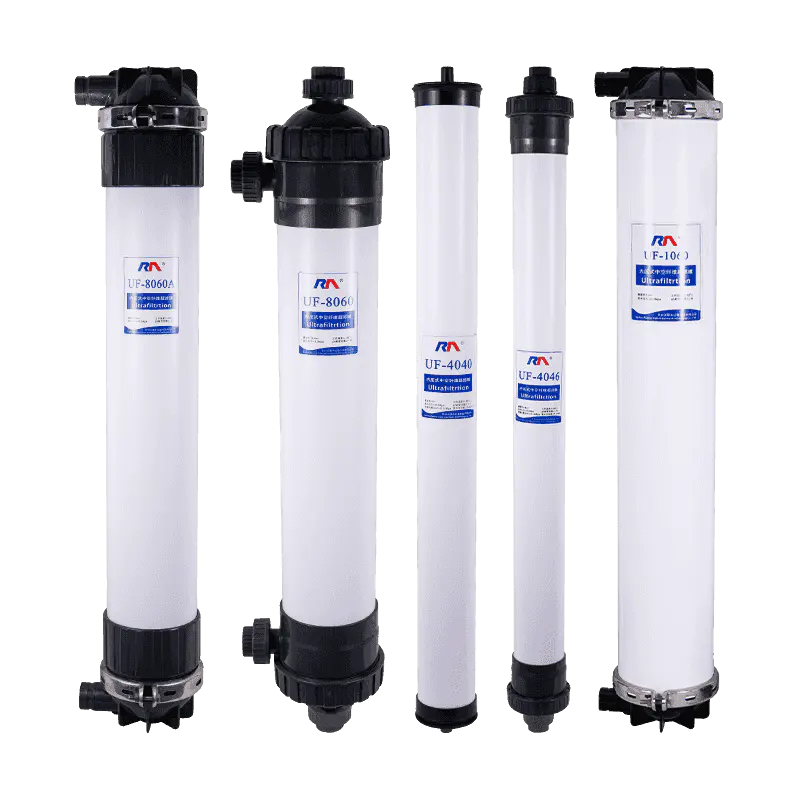
Ultrafiltration is a membrane-based separation process used in many water treatment systems to reduce suspended solids, colloids, bacteria, and other larger contaminants. For beginners, the term “4040” can be confusing because it usually describes the membrane element’s dimensions rather than a separate treatment technology. Understanding the module format, filtration role, and operating requirements makes it easier to judge where this type of membrane can fit.
What Does 4040 Mean?
In membrane terminology, 4040 generally refers to a standardized element size. The designation commonly indicates a membrane element with an approximately 4-inch diameter and 40-inch length. It is therefore primarily a physical format rather than an indication of filtration accuracy or membrane material.
This distinction is important when comparing products. Two 4040 elements can still differ in membrane material, membrane area, configuration, flux, operating pressure, and other specifications. System designers need to examine those technical details to determine whether a particular element is compatible with the equipment and treatment objective.
Ultrafiltration itself works by using a membrane with very small pores to separate water from larger suspended or dispersed substances. Unlike reverse osmosis, UF is not primarily intended to remove dissolved salts. Its main value is the physical removal of larger contaminants and the production of a cleaner feed stream for subsequent treatment.
Where UF Membranes Fit in Water Treatment
UF membranes can serve several functions within a complete treatment system. In some installations, they are used as a primary membrane filtration stage. In others, they act as pretreatment before reverse osmosis or another process that requires lower levels of suspended solids and microorganisms.
The exact role depends on the feed water and the desired final quality. Surface water, groundwater, municipal wastewater, and industrial process water can all have different contaminant profiles, so the treatment train should be designed around actual water conditions rather than simply choosing a membrane by its nominal size.
For organizations considering a uf membrane 4040, the first question should be what the membrane is expected to remove. Suspended solids, colloids, bacteria, and other particulate contaminants can be relevant targets for UF, while dissolved salts generally require a different treatment technology.
Why the Membrane Material Matters
Membrane material can influence chemical resistance, mechanical properties, cleaning compatibility, and long-term operating behavior. Common UF materials include polymeric options selected for different application requirements.
Runmo’s PAN ultrafiltration membrane product uses polyacrylonitrile, or PAN, as the membrane material. According to the product information, the membrane uses enhanced hydrophilic PAN material and is designed for stable filtration performance. The listed advantages include good hydrophilicity and resistance to organic pollution, while the product is intended for applications including water treatment and wastewater-related processes.
The material should still be evaluated alongside feed-water conditions and the proposed cleaning method. A membrane that performs well in one application may not be suitable for another where the chemical environment or contaminant profile is substantially different.
Understanding Runmo’s 4040 Product
Runmo’s PAN UF portfolio includes the RM-UF-4040 model, giving buyers a specific example of what a 4040-format element can look like in practice. This model uses a PAN membrane material and has a membrane area of 4 m² . Its listed design water yield is 0.2 m³/h at 0.1 Mand 25°C.
The RM-UF-4040 is listed in the internal-pressure ultrafiltration membrane element series.Its specifications include a membrane area of 4 m² and a design water yield of 0.2 m³/h at 0.1 MPa and 25°C. The manufacturer also provides limits for pH, turbidity, SDI, oil content, and other feed-water conditions.
These numbers should be interpreted as product specifications rather than guaranteed results in every installation. Actual water output depends on feed-water quality, temperature, operating pressure, fouling conditions, pretreatment, and system design. A proper evaluation should therefore compare the published specifications with the conditions of the intended application.
Common Uses for a 4040 UF Element
A 4040 element can be practical for systems where available installation space, required capacity, and equipment configuration call for a compact membrane module. UF technology can be used in water treatment as well as in processes where suspended material and microorganisms need to be reduced before water moves to another treatment stage.
For industrial applications, UF may support process-water preparation, wastewater treatment, or pretreatment for RO systems. In municipal and commercial systems, it can contribute to the production of cleaner water by reducing larger contaminants before downstream treatment or reuse.
The advantage of using a defined element format is also related to system planning. Engineers can estimate the membrane area and number of elements needed based on expected flow and the manufacturer’s design parameters. Replacement planning can then be tied to the same configuration, provided the replacement membrane is technically compatible with the existing system.
What to Check Before Ordering
Before selecting a membrane, buyers should collect basic feed-water information and determine the intended treatment result. Turbidity, suspended solids, organic content, temperature, pH, and other relevant parameters can affect membrane selection and operating conditions.
Equipment compatibility is another practical consideration. Check the dimensions, membrane area, housing arrangement, connections, working pressure, and cleaning requirements before ordering. These details can be particularly important when replacing membranes in an existing installation.
Commercial considerations should also be kept in view. Price, quality, delivery time, customization, and technical support can all influence the suitability of a supplier for a project. For water-treatment engineering companies and smaller businesses, both technical and procurement requirements should be considered during membrane selection.
Choosing the Right Place for UF
A 4040 UF membrane is best understood as a membrane element format used within a broader ultrafiltration process, not as a standalone treatment solution. Its effectiveness depends on membrane material, feed-water characteristics, operating conditions, pretreatment, and the quality target established by the project.
Runmo provides UF membrane options in different materials and configurations, alongside RO, nanofiltration, seawater, and other membrane products. For buyers comparing 4040UF membranes, the RM-UF-4040 can be assessed based on its published specifications and the requirements of the intended system. A careful comparison of those factors can turn a basic membrane specification into a more informed purchasing decision.
