

Accurate accident investigation plays a critical role in law enforcement, helping police agencies determine incident causes, document evidence, and support fair decision-making. However, traditional investigation methods often rely on manual measurements, complex equipment, and time-consuming reconstruction processes. As accident scenes become more complicated, agencies need digital solutions that improve accuracy while reducing operational challenges.
Modern accident investigation software is transforming how police departments analyze collision scenes. By combining 3D reconstruction, artificial intelligence, and advanced visualization technologies, these platforms allow investigators to convert real-world footage into detailed digital environments. Icecypress Technology, a spatial intelligence AI company specializing in 3D and AI technologies, provides the Rusa Rapid 3D Scene Reconstruction System to help agencies achieve high-fidelity accident reconstruction without depending on professional surveying equipment.
Why Accident Investigation Software Is Becoming Essential for Police Agencies
Police agencies face increasing demands for faster and more reliable accident investigations. Traditional reconstruction approaches may require specialized tools, extensive field measurements, and experienced technicians to collect and interpret evidence. These requirements can increase investigation time and create challenges when dealing with complex or large-scale accident scenes.
Accident investigation software provides a more flexible approach by enabling investigators to capture scene information and create accurate digital models. Instead of relying only on photographs, sketches, and manual measurements, officers can use 3D reconstruction technology to preserve scene details and review incidents from multiple perspectives.
For law enforcement organizations, the value of these solutions extends beyond efficiency. Digital reconstruction optimizes evidence management, supports clearer communication between teams, and helps present accident details in a more understandable format.
Key Factors to Consider When Selecting Accident Reconstruction Tools
When evaluating accident reconstruction tools, police agencies should consider several important factors, including accuracy, usability, processing speed, and adaptability. A suitable solution should support investigators with reliable data while remaining practical for daily operations.
Accuracy is one of the most important requirements. Accident scenes often involve small details such as tire marks, road damage, obstacles, and vehicle positions. Even minor measurement errors can influence reconstruction results. Advanced systems should provide precise measurements and detailed scene restoration to support professional analysis.
Another important consideration is operational flexibility. Police agencies may need to investigate accidents in different environments, including urban roads, highways, and challenging weather conditions. Tools that can adapt to various scenarios allow investigators to complete their work more efficiently.
Fast 3D Reconstruction Simplifies Accident Scene Modeling
One major advantage of modern accident investigation software is the ability to create digital accident models quickly. Traditional reconstruction methods may involve complex procedures before investigators can begin analysis, while automated 3D reconstruction can significantly shorten preparation time.
Icecypress Technology’s Rusa Rapid 3D Scene Reconstruction System enables minute-level modeling through simplified operations. The system does not require tedious manual adjustments and can generate reconstruction previews quickly. For high-precision applications, the platform supports reconstruction within 40 minutes while maintaining detailed scene information.
The flexible frame extraction capability allows the system to adapt to different image collection speeds and scenarios. This makes it suitable for various accident investigation environments where rapid data processing is required.
High-Fidelity Visualization Improves Evidence Understanding
Clear visualization is essential when investigators need to analyze accident scenes or communicate findings. Conventional reports may not fully represent complex spatial relationships, making it difficult for different stakeholders to understand the situation.
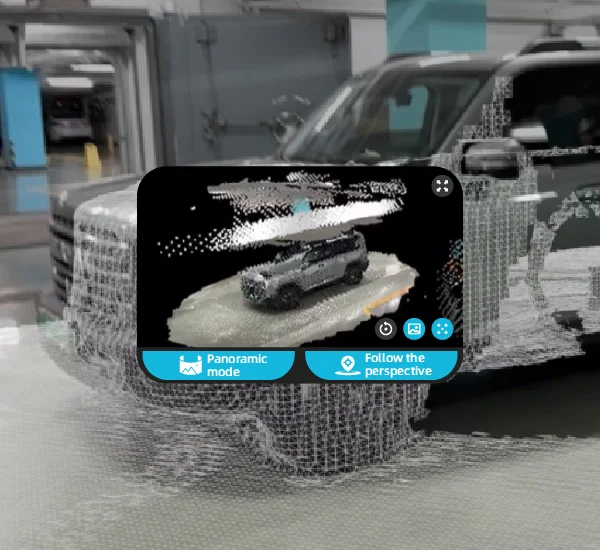
High-fidelity rendering technology provides a more immersive way to review reconstructed scenes. Rusa uses a self-developed interactive browser to transform point cloud data into realistic 3D environments. The system restores textures, lighting effects, and spatial details to create a clearer representation of the accident location.
With real-time rendering performance of 30 frames per second or higher, the platform allows users to smoothly explore reconstructed scenes. Investigators can review details from different angles, improving their understanding of accident conditions.
AI Recognition Enhances Investigation Efficiency
Artificial intelligence is becoming an important component of modern accident reconstruction tools. Manually identifying every relevant element in an accident scene can require significant time and experience, especially when scenes contain large amounts of visual information.
Rusa applies AI-powered recognition technology to automatically identify important features such as tires, obstacles, traffic signs, and road damage. By focusing on key elements and reducing unnecessary visual information, the system helps investigators concentrate on evidence that directly affects reconstruction analysis.
This intelligent assistance optimizes workflow efficiency while reducing the possibility of overlooking important details. For police agencies handling multiple investigations, AI-supported analysis can help optimize resource allocation.
Centimeter-Level Measurement Supports Reliable Accident Analysis
Precise measurement is fundamental to accident reconstruction. Investigators often need to calculate distances, areas, volumes, and relationships between different objects to understand how an incident occurred.
Rusa provides centimeter-level measurement capabilities with measurement errors of less than 2 cm. The system supports length, area, volume, true distance, and horizontal distance calculations between points. Investigators can also perform multiple measurements simultaneously within the digital model.
As one of the practical accident reconstruction tools, the platform allows users to mark measurement values directly within the model browser. It also supports customized reports and multiple export formats, making it easier to share investigation results across departments.
Building More Intelligent Accident Investigation Processes
Digital transformation is reshaping accident investigation by helping police agencies move from manual reconstruction toward data-driven analysis. Solutions that combine 3D modeling, AI recognition, and precise measurement provide investigators with faster and more reliable ways to understand complex incidents.
Icecypress Technology’s Rusa Rapid 3D Scene Reconstruction System demonstrates how advanced spatial intelligence can support modern law enforcement needs. By offering fast reconstruction, realistic visualization, intelligent recognition, and accurate measurement, the system helps agencies improve investigation efficiency and evidence presentation.
As public safety organizations continue to adopt digital tools, accident investigation software will become increasingly important for creating more efficient, accurate, and transparent reconstruction processes. With advanced accident reconstruction tools, police agencies can better manage complex cases and make informed decisions based on reliable digital evidence.
