

The development of sheet metal machinery is easier to understand as a sequence of changes in control. Early equipment depended heavily on mechanical motion and direct operator adjustment. Hydraulic power expanded forming capability, numerical control reduced manual positioning, CNC made programs repeatable, and laser cutting introduced flexible digital geometry.
More recently, feeders, exchange tables, and integrated handling have shifted attention to the movement of material between machines. Modern sheet metal fabrication equipment therefore includes both simple machines and highly programmable systems.
New technology has usually added another production option rather than making every earlier process obsolete.
How Did Mechanized and Hydraulic Machines Establish the Core Processes?
The earliest industrial machines were defined by the operation they performed. Shears cut sheet, press brakes formed bends, rolling machines created curved sections, and presses or ironworkers handled punching and related work.
Mechanical and hydraulic systems gave factories controlled force and repeatable motion, while operators remained responsible for much of the positioning and setup.
Those process categories still exist because the underlying manufacturing tasks remain useful. A straight blank still has to be cut, a flange still has to be bent, and a cylindrical section still has to be rolled. Later technology changed how those operations are controlled rather than eliminating their purpose.
RBQLTY’s current range includes press brakes, shearing machines, rolling machines, punching presses, and ironworkers alongside newer cutting systems. The combination shows how established forming methods continue to sit beside more recent technologies in modern workshops.
How Did Numerical Control Change Sheet Metal Fabrication Equipment?
Numerical control moved part of machine setup from physical adjustment to entered values. CNC expanded that idea by storing programs, coordinating multiple axes, managing tool or material data, and repeating more complex sequences.
Press brakes show this change clearly. The company lists NC and CNC machines. Published DA-53T configurations include tool, material, and product libraries, crowning control, and multiple controlled axes. DA-69T models add graphical programming and 3D visualisation.
The important change was not simply a new control panel. Production information became reusable. A job returning later could start from a defined digital setup instead of being recreated entirely from memory.
Operator skill also changed in emphasis. More effort moved toward program preparation, tooling decisions, verification, and process adjustment. Direct manual positioning remained relevant, but the control system carried more of the repeatable information.
Digital records also made job transfer more structured. Program names, material settings, tool references, and axis positions could remain associated with a specific part instead of being reconstructed from handwritten notes.
What Did Industrial Laser Cutting Machines Add to the Technology Timeline?
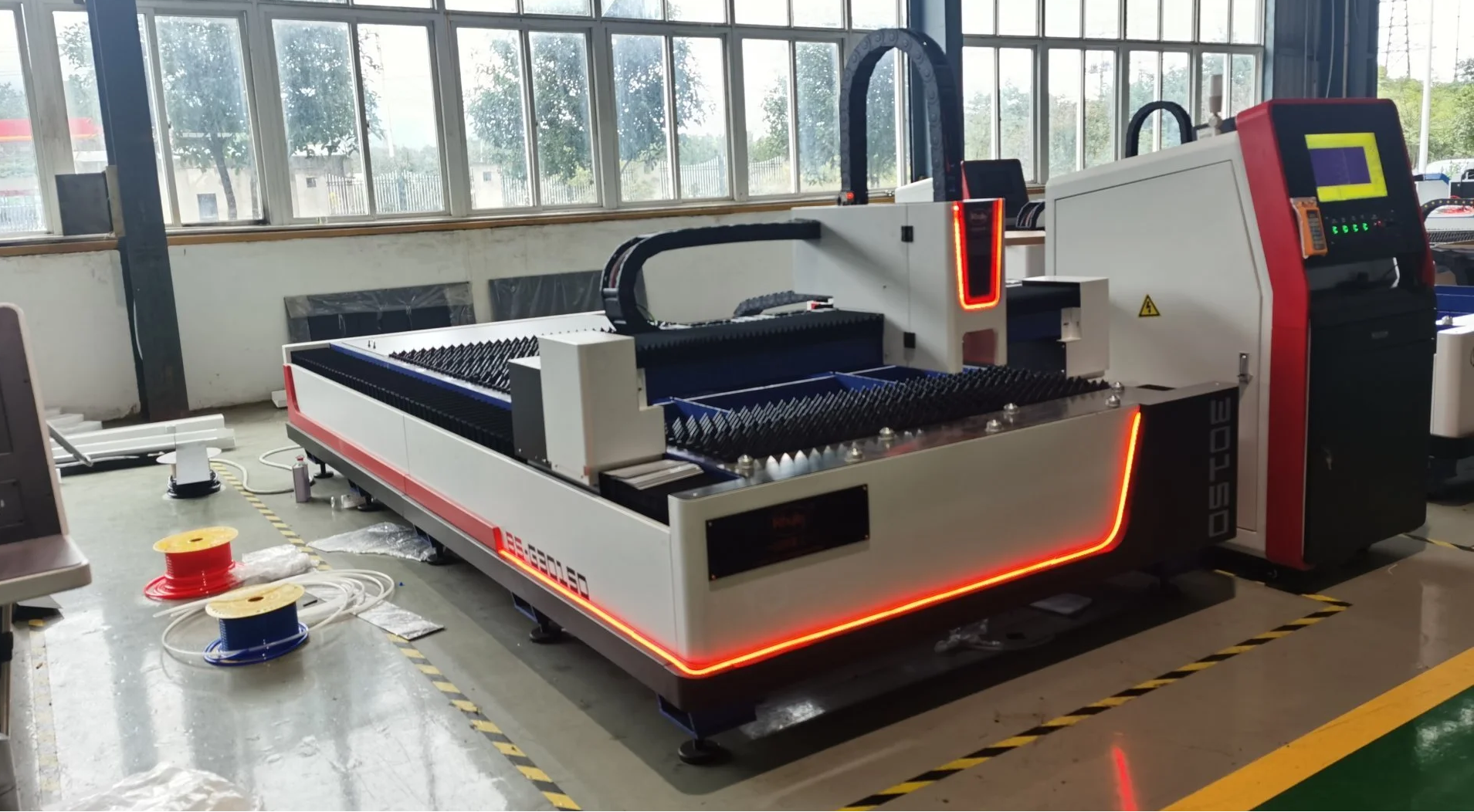
Laser cutting introduced a different kind of flexibility. A shear follows a straight blade line, while a CNC laser moves along programmed contours. That gave manufacturers a direct route from digital geometry to cut parts with holes, curves, slots, and irregular outlines.
Modern industrial laser cutting machines appear in several architectures. RBQLTY lists single-table systems, enclosed exchange-table machines, sheet-and-pipe models, dedicated pipe cutters, long-format equipment, and machines with feeding functions.
Industrial laser cutting machines also changed the way part data entered production. Digital files became closely connected with nesting, programming, and cutting paths. More geometry could be completed at the cutting stage before parts moved to forming or assembly.
Mechanical shearing still retained an important role for direct straight blanking. The technology timeline therefore branched rather than moving in a single direction.
Different cutting methods continued to coexist because they solved different geometric and production tasks. Flexible laser processing expanded, while established cutting methods stayed useful for work that matched their simpler motion.
Why Is the Current Stage Focused on Integration and Material Flow?
Once individual machines became programmable, attention shifted toward loading, unloading, feeding, repositioning, and transfer between operations. A fast cutting cycle brings limited benefit if material spends long periods waiting to enter or leave the machine.
This explains the growing use of exchange tables, feeders, servo feeding devices, and line-oriented systems. RBQLTY lists laser machines with feeders as well as CNC feeding platforms, servo roller feeders, and coil cutting or slitting equipment.
Integration is the defining feature of this stage in sheet metal fabrication equipment. The machine is no longer viewed only as an isolated cutting or forming unit. Its relationship with material handling, data, and downstream equipment also shapes output.
Factories still have room to choose how far this integration goes. Stable products with simple handling often work well with modest automation. More varied production can justify additional feeding, positioning, or transfer functions.
The modern development path is therefore about giving manufacturers more ways to connect operations, not forcing every workshop toward the same automation level.
Conclusion
Mechanical and hydraulic machines established the core operations; NC and CNC made settings repeatable; laser cutting expanded digital geometry; integrated handling connected work between machines. RBQLTY supplies equipment across several of these technology levels.
The evolution of fabrication equipment is therefore less about replacing every older process and more about adding new ways to control information, geometry, and material flow where they improve production.
