

Sizing a generator for a residential property involves more than adding up the wattage printed on household appliances. Air conditioners and borehole pumps can draw several times their normal running power when they start, while a generator’s rated output may change depending on whether it runs on petrol, LPG, or natural gas.
These details become particularly important when a house relies on one generator for both heavy equipment and sensitive electronics. For homeowners and estate developers comparing whole-house backup options, the key is to find a setup that can handle peak demand, work with the available fuel supply, and deliver enough power under the conditions in which it will actually be used.
Defining the Whole-House Load Profile
Modern residential properties carry complex electrical signatures that change drastically throughout the day. A home running two 1.5HP split air conditioners, a water pumping machine, and multiple refrigerators creates massive starting load spikes.
Standard backup units often stall out when these heavy appliances compressors attempt to kick on simultaneously. Capturing this total startup wattage is the first step in sizing an appropriate portable generator with inverter for continuous residential support.
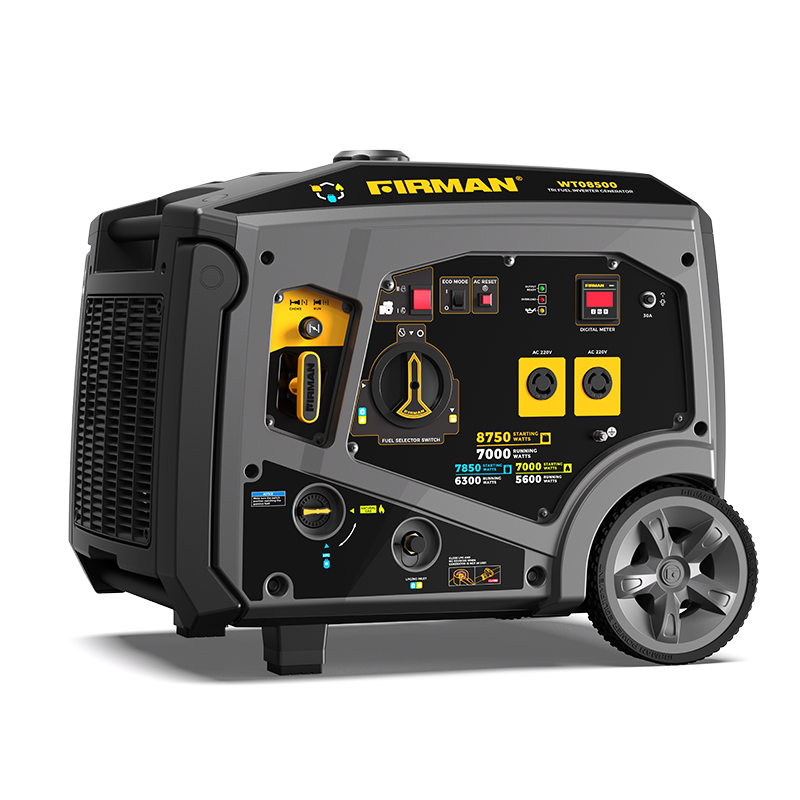
Deploying a versatile multi-fuel generator from Firman allows homeowners to manage these heavy loads while maintaining flexibility in their running costs. Additionally, buyers cannot simply look at the highest printed number on the box; they must strictly differentiate between starting watts and continuous running watts.
A unit capable of handling massive spikes during startup will settle into a much lower continuous output once the heavy motors stabilize. Failing to account for this operational drop leaves critical home infrastructure severely underpowered.
Combustion Options and Fuel Supply Logistics
Fuel scarcity and sudden price fluctuations frequently disrupt households relying exclusively on a single combustion method. Storing massive quantities of petrol safely within a residential compound presents serious fire hazards and fuel degradation issues over time.
Conversely, diesel offers better long-term storage stability but typically requires investing in heavy, noisy industrial engines that disrupt neighborhood peace. So switching fuel sources dynamically offers a critical tactical advantage when local filling stations run completely dry.
Operating a tri-fuel or multi fuel generator mitigates these regional supply chain risks efficiently. Families can rely on piped natural gas for uninterrupted daily operation, switch to stored LPG cylinders during localized disruptions, and keep petrol as a final emergency reserve.
Managing these transitions safely requires shutting down all active household loads and closing current valves before introducing the new combustible. This logistical flexibility ensures the property remains highly functional regardless of which petroleum product is currently available.
Power Quality and Sensitive Appliance Protection
Beyond sheer wattage, the actual electrical cleanliness of the backup supply dictates the survival of modern household appliances. Traditional open-frame engines often produce jagged electrical sine waves containing high total harmonic distortion.
Sending this unregulated voltage into smart televisions, inverter refrigerators, or home office servers can instantly fry their sensitive microprocessors. Estate developers must prioritize clean energy delivery to avoid catastrophic damage to their clients’ premium home electronics.
Selecting a portable generator with inverter resolves this exact vulnerability by mechanically scrubbing the electrical output. These advanced alternators convert the initial raw alternating current into direct current before digitally recreating a perfectly smooth AC wave.
This meticulous conversion process mirrors the stability of a premium municipal grid, keeping delicate circuitry completely safe during violent load fluctuations. Homeowners can safely charge laptops and operate smart home security systems without fearing sudden, destructive voltage spikes.
Capacity Ratings Across Different Fuel Types
A critical engineering reality often overlooked during procurement is how changing combustible gases alters maximum electrical output. Internal combustion engines produce varying levels of kinetic energy depending on the specific energy density of the liquid or gas burned.
For example, a multi-fuel generator will always deliver its absolute highest wattage when running on highly combustible liquid petrol. The physical properties of propane and natural gas yield slightly less mechanical force per combustion stroke.
This physical law means that a Firman system generating 5.50kW of continuous power on petrol might drop to 5.00kW on LPG and 4.50kW on natural gas. Understanding these exact output thresholds is crucial before permanently wiring a unit into a household breaker panel.
Homeowners attempting to run their entire HVAC system on a piped natural gas connection might find themselves lacking the wattage they previously enjoyed on petrol. Calculating the strict maximum load for the weakest available fuel source prevents unexpected overload trips.
Strategic Deployment for Estate Developers
Supplying reliable, clean electricity stands as the primary selling point for premium residential estates in South Africa, Ghana, and Nigeria. Developers often shy away from massive centralized diesel plants due to their immense capital expenditure and heavy maintenance overhead.
Instead, deploying localized, flexible power plants to individual residential units distributes the risk and operational cost fairly. This decentralized approach gives homeowners total autonomy over their specific energy consumption and preferred combustion type.
Equipping properties with a reliable portable generator with inverter satisfies the demand for both raw capacity and acoustic comfort. Residents appreciate the significantly quieter operation compared to traditional open-frame contractor equipment running nearby.
Firman engineers their specific hybrid units with heavy-duty mobility kits, ensuring the equipment can be repositioned easily for routine maintenance. Ultimately, empowering homeowners with these flexible power capabilities guarantees that everyday family life continues unhindered through any regional infrastructure failure.
