


With the global demand for Omega-3 concentrates growing rapidly, the design and equipment quality of a fish oil refining production line and fish oil fractionation production line directly determine key product indicators such as acid value, peroxide value, color, smoke point, and oxidative stability. As a leader in the oil engineering sector in China, Ocean has built over 200 oil refining lines and more than 40 fractionation lines worldwide. For many years, Ocean has held a dominating, monopoly-level market share in China’s fractionation equipment sector, making it the undisputed technology leader.
Technical Challenges in Fish Oil Fractionation: Why Ordinary Equipment Fails?
Fish oil is fundamentally different from vegetable oils such as palm oil. Rich in long-chain polyunsaturated fatty acids (EPA and DHA), fish oil presents three major challenges in fractionation:
- Extremely low crystallization temperature – Saturated fatty acid components (stearic acid, palmitic acid) in fish oil crystallize at -10°C to -5°C, much lower than the 5–15°C range for palm oil fractionation. This requires a strong refrigeration system with large heat exchange area and precise temperature control.
- High viscosity and wall sticking – At low temperatures, fish oil becomes highly viscous, easily adhering to the inner walls of crystallization tanks, reducing heat transfer efficiency and causing uneven crystal formation.
- Oxidation sensitivity and need for inert protection – Unsaturated fatty acids in fish oil oxidize rapidly upon contact with air, causing off-flavors and high peroxide values. The entire fractionation process (crystallization, maturation, filtration) must operate under nitrogen blanketing or high vacuum.
Ocean’s Core Technologies: From Crystallization Curve to Continuous Automated Fractionation
To address these challenges, Ocean has implemented several proprietary technologies in its fish oil refining and fractionation production line, setting it far apart from outdated, low-efficiency designs still found in parts of the industry.
1. Independent Chilled Crystallization System with Accurate Crystallization Curve Control
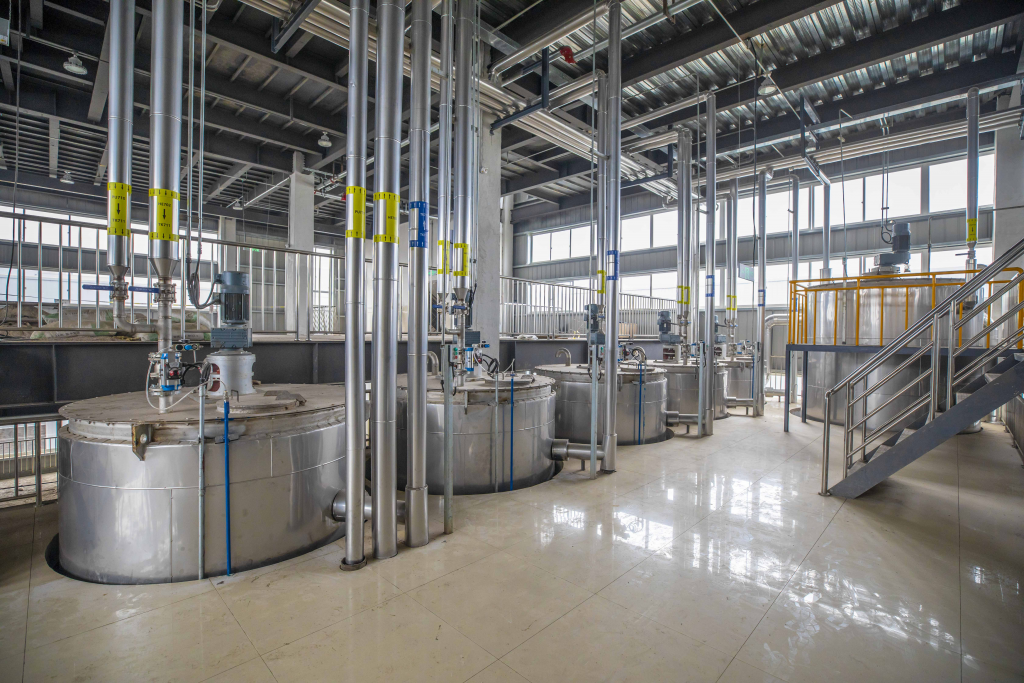
- Number and design of crystallizers – Unlike some conventional solutions that offer only one crystallizer without PTFE scrapers or nitrogen protection, every Ocean fish oil fractionation line includes 2–3 crystallizers (depending on capacity). Each crystallizer is equipped with a frequency-controlled frame agitator + PTFE scrapers and large internal cooling coils to ensure uniform temperature reduction without dead zones.
- Intelligent crystallization curve – Ocean’s PLC automation system (GE or Siemens) presets and automatically executes a multi-stage crystallization curve – rapid cooling to the nucleation point, followed by slow linear cooling for crystal maturation, and finally constant-temperature conditioning. The entire process is computer-controlled without manual intervention.
- Competitive advantage – Most conventional solutions use a crude “one-step cooling” approach, resulting in poor separation of stearin and olein and substantially lower fractionation yields compared to Ocean’s equipment.
2. Fully Enclosed Nitrogen Blanketing and Vacuum System
To prevent oxidation, Ocean integrates nitrogen filling ports and vacuum venting into the crystallizers, filters, and intermediate piping. Key sections (crystallization, maturation, filtration) operate under nitrogen or slight vacuum, completely isolating the oil from air.
3. Continuous Filtration with Automatic Cleaning
Ocean’s fish oil fractionation line uses membrane filter presses, offering clear advantages over ordinary plate-and-frame presses or centrifuges:
- Higher separation efficiency – After filling, the membrane squeezes the cake to further remove residual olein, increasing olein yield and reducing oil loss.
- Automatic cleaning cycle – A dedicated cleaning oil tank and heater enable one-button automatic cleaning, dramatically reducing labor and preventing contamination from manual cleaning.
Proven Track Record: 200+ Refining Lines and 40+ Fractionation Lines – Monopoly Market Position
Ocean has achieved multiple records in China’s oil engineering industry:
- More than 200 refining lines for various oils – fish oil, palm oil, soybean oil, rapeseed oil, rice bran oil, animal oils.
- More than 40 fractionation lines – palm oil, fish oil, cottonseed oil, beef tallow)
- Ocean has held a monopoly-level market share in China’s fractionation equipment sector for many consecutive years, far surpassing other competitors.
This position has been earned through continuous investment in core technologies: crystallization curve control, high automation (PLC fully automatic, no manual on-site operation), and continuous process design.
Client Value: Written Performance Guarantee and Quantifiable ROI
Ocean provides a written quality guarantee for every fish oil refining and fractionation production line. These specifications are the market entry threshold for export-grade, edible-grade, or nutraceutical-grade fish oil.
Economically, Ocean’s high-vacuum system, waste heat recovery, and low-temperature deodorization technology reduce steam consumption to as low as ≤75 kg/t in physical refining – saving more than 200 kg per ton compared to conventional chemical refining. Annual operating cost savings can reach hundreds of thousands of dollars.
Conclusion
Choosing Ocean for your fish oil refining production line and fish oil fractionation production line means adopting a mature, proven solution that addresses the three major technical challenges: low-temperature crystallization, high-viscosity handling, and oxidation control. Whether you need a 5 TPD pilot line or a 150 TPD industrial plant, Ocean provides full services from process design, equipment manufacturing, PLC automation, and installation to commissioning.
