

A C&I microgrid converter has to satisfy several engineering demands at the same time. It must move substantial power without wasting excessive energy, fit within practical equipment space, manage heat over long operating periods, and remain useful when the site changes between grid-connected and islanded conditions.
Those requirements make semiconductor choice part of system design rather than a component-level detail. A sic inverter becomes relevant when its device characteristics support the wider needs of a microgrid energy storage system instead of improving only one laboratory metric.
System Integration Determines Whether SiC Becomes a Microgrid Advantage
A converter inside a C&I microgrid does not operate independently from batteries, loads, utility power, or backup generation. Load-fluctuation handling and synchronization are built into the same unit, alongside automated diesel-generator coordination and self-learning of key generator parameters.
These functions place semiconductor performance inside a broader operating architecture where power conversion and local grid support have to work together. The interface with site-level energy management also matters because dispatch changes, islanding events, generator starts, and battery limits can all shift the operating point seen by the power stage.
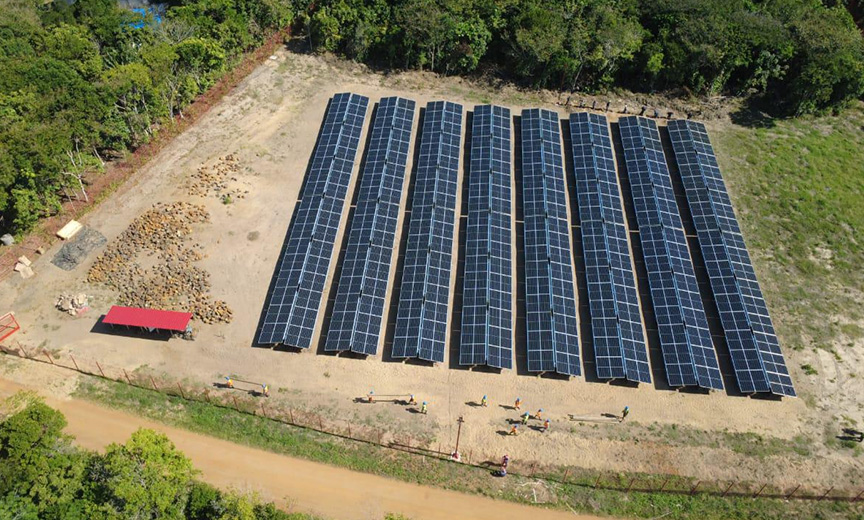
An island microgrid project in Madagascar shows that relationship at the system level. WidenEdge lists the 2025 project with a 500kW diesel generator and a 450kW/800kWh energy-storage system providing two hours of backup power.
The local grid is unstable, the system is designed to move to off-grid operation after a grid outage, and diesel generation provides backup during prolonged outages. A microgrid energy storage system in this setting depends on coordinated storage conversion, local grid-forming operation, and conventional generation rather than on converter efficiency alone.
Efficiency Is Only the First Evaluation Dimension
Conversion loss matters because battery energy passes through the inverter whenever the system charges or discharges. Lower switching loss can reduce the amount of stored energy turned into heat, especially in designs that use higher switching frequencies.
Silicon carbide therefore gives converter designers additional room to pursue efficient power conversion while maintaining the dynamic behavior required by storage applications. Efficiency alone does not establish suitability. A sic inverter still depends on topology, magnetics, filters, cooling, and control strategy, so the complete converter determines how much of the device-level advantage reaches the AC side.
For C&I projects, the relevant question is whether lower power-stage loss remains useful across the load range and operating modes the site actually uses. A converter that performs well only near rated output may deliver less lifetime value at a facility whose battery spends many hours at partial load. The duty cycle therefore belongs in the efficiency assessment.
Power Density Connects Semiconductor Choice to Project Space
Commercial and industrial sites often have limited electrical-room space, fixed outdoor pads, or container dimensions that cannot expand freely. Where the topology permits, operating the power stage at higher frequency can shrink some of the magnetic and filtering hardware around it.
That creates a path toward higher power density, which can reduce the physical burden of the conversion stage inside a microgrid energy storage system. Compactness has to remain compatible with service access and thermal management. A smaller cabinet offers little project value if heat cannot be removed or maintenance becomes difficult.
SiC therefore matters most when its lower switching loss and higher-frequency capability are translated into a balanced mechanical and electrical design rather than treated as a reason to minimize enclosure size at any cost. Cable access, protection clearances, ventilation paths, and future service still occupy physical space, so useful power density is a system-level outcome rather than a simple watts-per-liter target.
Thermal Margin Supports Long-Term Operating Reliability
Every conversion loss becomes heat somewhere inside the equipment. With less heat originating in the semiconductor stage, the thermal design gains additional headroom before derating thresholds become relevant. That margin is particularly relevant where storage equipment experiences changing loads or operates in demanding environments.
In WidenEdge’s MGC MK2, grid-forming control supports local voltage and frequency when utility power becomes unavailable, while 100% unbalanced-load capability addresses uneven demand between phases. Seamless mode transfer and sudden load changes can rapidly alter the converter’s current and heat generation, making thermal management important to sustaining the required output. Its high-protection design is intended for harsh microgrid sites, where cooling performance and environmental exposure must be considered together.
Thermal margin becomes particularly valuable when load changes coincide with high ambient temperature. The wider MGC series is designed for a −25°C to +60°C operating range, with rated output at 45°C ambient. Lower semiconductor losses reduce part of the heat that cooling systems must remove, but actual site performance still depends on the selected inverter’s cooling arrangement, installation conditions, and derating limits.
Four Dimensions Belong in the Same Engineering Decision
Suitability is ultimately tested against the C&I operating duty rather than against a single semiconductor metric. Lower switching loss can reduce conversion waste; higher-frequency design can support more compact hardware; reduced heat generation can create additional thermal margin; and advanced control functions determine how the converter behaves when grid conditions or loads change.
WidenEdge’s MGC MK2 illustrates that combined perspective by pairing SiC-based conversion with grid-forming behavior, unbalanced-load support, synchronization, load response, and diesel-generator coordination. A sic inverter earns its place in a C&I project when those device-level advantages remain useful inside the actual operating architecture.
A SiC inverter is suitable when its lower-loss power stage remains compatible with the site’s load profile, islanding duties, backup architecture, and installation constraints; device performance alone does not establish that fit.
SEO Title: What Makes a SiC Inverter Suitable for C&I Microgrid Energy Storage Systems? | WidenEdge
Meta Description: Read our latest insights on What Makes a SiC Inverter Suitable for C&I Microgrid Energy Storage Systems? Explore efficiency, density, and system integration.
